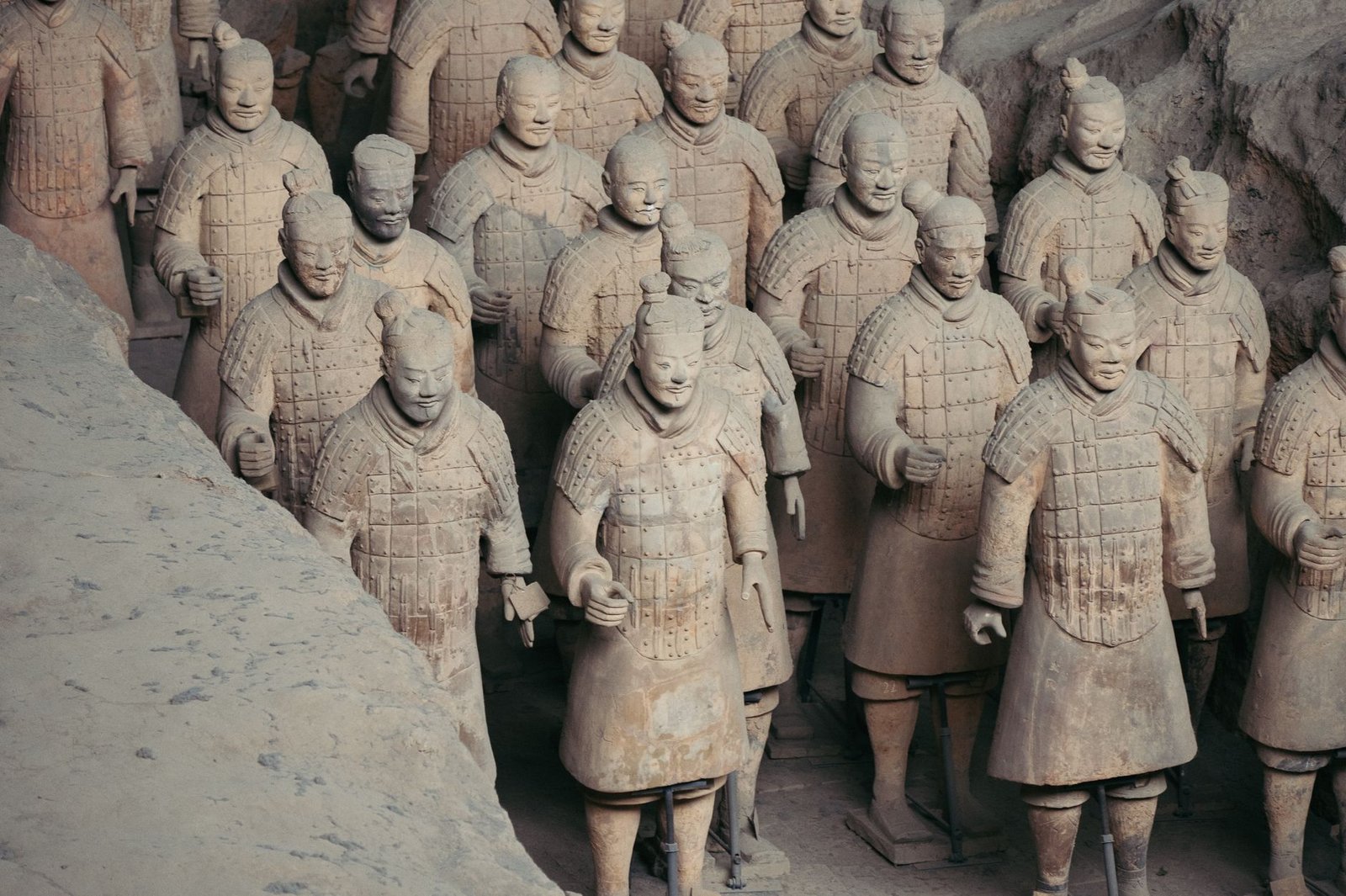
In 1974, farmers digging a well near Xi’an in central China struck something that would stun the world: a life-sized clay soldier, then another, then thousands. The Terracotta Army had slept for more than two millennia, guarding the resting place of China’s first emperor. Yet here is the strange part. Nearly half a century of excavation later, the one thing everyone most wants to see — the burial chamber of Qin Shi Huang himself — has never been touched. The tomb sits beneath a forested mound, perfectly visible, perfectly accessible, and perfectly sealed. So why has Qin Shi Huang’s tomb never been opened?
The Emperor Who Wanted to Live Forever
Qin Shi Huang unified the warring states of China in 221 BCE, standardized its writing, currency and roads, and connected early walls into the ancestor of the Great Wall. He was also obsessed with immortality, sending expeditions to find elixirs of eternal life and, according to legend, swallowing mercury pills he believed would preserve him.
That obsession shaped his death as much as his life. Construction of his mausoleum reportedly began the moment he took the throne as a teenager and continued for decades, employing — by ancient accounts — hundreds of thousands of laborers. The tomb was not meant to be a grave. It was meant to be an entire empire in miniature, a palace complex that the emperor could rule forever in the afterlife. The clay soldiers were only the outer garrison. The real wonder lies deeper, under the untouched central mound.
A Palace Described but Never Seen
Our best description of what waits inside comes from the historian Sima Qian, writing roughly a century after the emperor’s death. He recorded that the tomb contained palaces and towers, treasures beyond counting, and ceilings studded with pearls to represent the heavens. Crossbows were said to be rigged to fire automatically at intruders.
Most hauntingly, Sima Qian wrote that the floor of the tomb was shaped into a map of the empire, with the great rivers and the sea reproduced in flowing mercury, kept in motion by some hidden mechanism. For centuries this sounded like pure myth — exactly the kind of flourish an ancient chronicler might invent. Then modern science took a closer look at the dirt.
The Rivers of Mercury
When researchers sampled the soil of the burial mound, they found something they did not expect: concentrations of mercury far higher than the surrounding countryside, clustered in a pattern across the central tomb area. The distribution even loosely echoes the geography of ancient China, as if a mercury “sea” really does pool where the eastern coast would lie.
This is the single biggest reason the chamber remains sealed. Liquid mercury is intensely toxic, and its vapor is worse. If the tomb genuinely holds pools of the metal, cracking it open could release a poisonous cloud that would endanger excavators and, potentially, the surrounding region. No one wants to be responsible for unleashing a 2,200-year-old toxic trap. Far from debunking Sima Qian, the chemistry suggests he was reporting something real — and dangerous.
The Preservation Problem
Mercury is not the only obstacle. Chinese archaeologists remember, with real pain, what happened to the Terracotta Army itself. When the warriors were first unearthed, many were brightly painted in reds, greens, purples and blues. Exposed to dry air, that pigment flaked and faded within minutes to hours. Soldiers that had kept their colors for two thousand years lost them almost as soon as human eyes saw them.
Now imagine that problem multiplied across silk, lacquer, wood, textiles and organic treasures sealed in a stable underground environment. Open the chamber with today’s tools and you risk destroying the very things you came to save. Archaeology has learned humility from disasters like the clumsy early digging at Troy, where crude excavation erased as much history as it revealed. The official Chinese position is essentially patience: better to wait for technology that can excavate and preserve at the same time than to gamble an irreplaceable site on present-day methods.
Why Patience May Be the Wisest Choice
There is also sheer scale. The full mausoleum complex covers an area of dozens of square kilometers, and the central tomb mound alone is enormous. Probing it with non-invasive tools — remote sensing, soil chemistry, muon and magnetic surveys — has mapped underground structures without a single shovel breaking the burial chamber. These scans hint at a layered, multi-chambered interior, but they cannot show the colors, the inscriptions, or whatever lies on that mercury map.
Some scholars argue the tomb should stay closed indefinitely out of respect, much as debates swirl around disturbing other ancient burials. The same ethical questions echo through stories like the curse of Tutankhamun, where the line between discovery and desecration grows blurry. For now, the cautious consensus holds: the first emperor’s rivers of mercury will keep flowing in the dark. The tomb is a riddle we have chosen not to solve — yet.
The Mystery Still Waiting Underground
Qin Shi Huang built a buried world to cheat death, and in a strange way he succeeded: his palace remains untouched, its secrets intact, its dangers unproven and unprobed. Whether it hides automatic crossbows, pearl-studded heavens, or simply a brilliant king’s final boast, we may not know in our lifetimes. The Terracotta Army he never meant us to find already rewrote what we thought we knew about ancient China — much like the eerie bronzes that raise their own questions in the story of who built the Sanxingdui bronze masks.
Want the full story — the historian’s chilling account, the mercury maps, and what scans are revealing beneath the mound? Watch our deep-dive on the Mysteries of History YouTube channel, where we walk through the evidence and the theories in detail. Subscribe and come explore the sealed tomb with us.
Enjoyed this? More videos on the Mysteries of History YouTube channel.