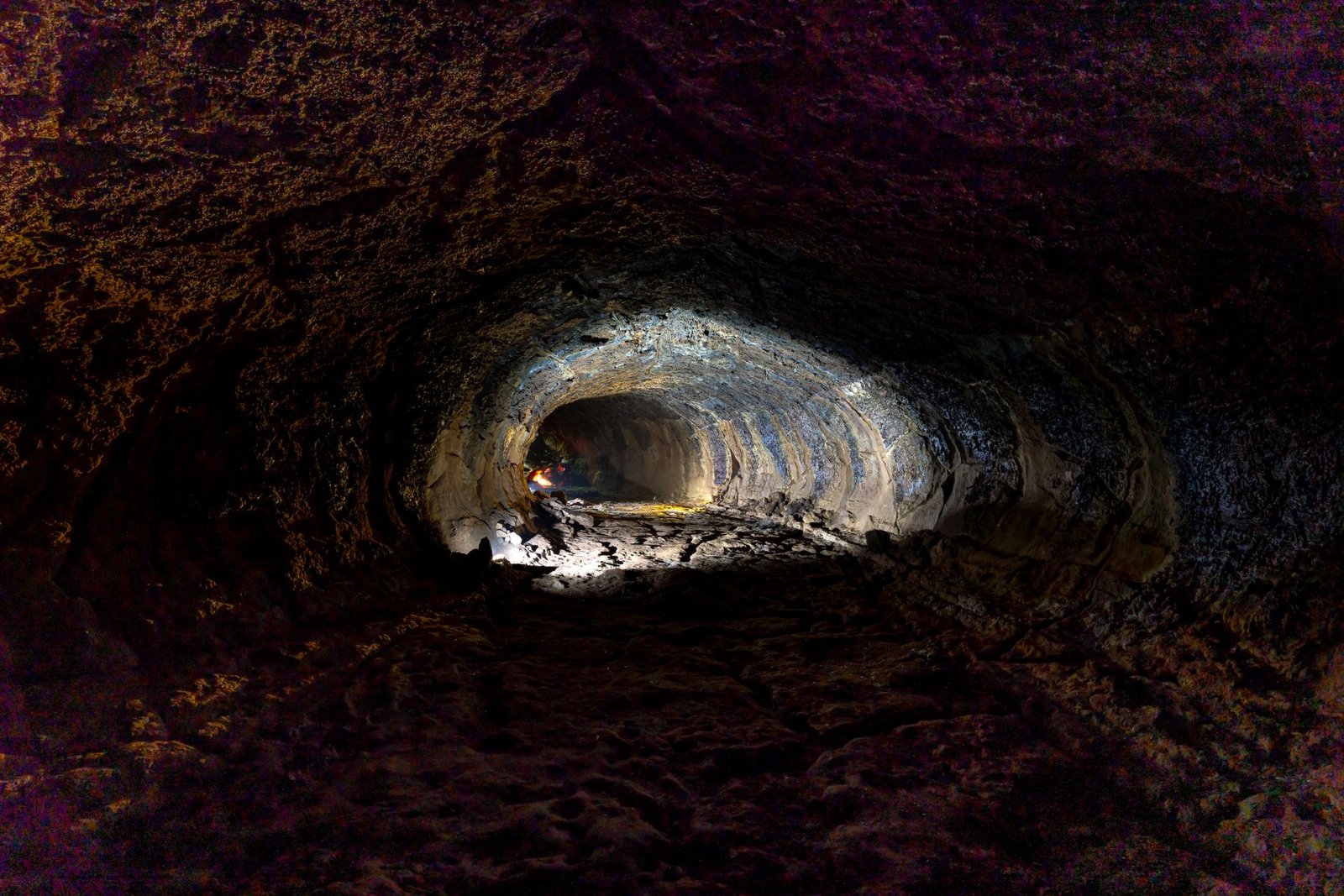
In 1963, a man in the Turkish region of Cappadocia knocked down a wall in his basement during renovations. Behind it was not a hidden room but a dark passage — and beyond that, another, and another. He had stumbled into Derinkuyu, a vast underground city carved straight down into volcanic rock, plunging some 18 levels and roughly 85 metres (280 feet) below the surface. It could shelter thousands of people, along with their livestock, food stores, and even their wine presses. The obvious question almost asks itself: why was the underground city of Derinkuyu built, and who had the desperation and skill to dig it?
A City Hidden Beneath a Village
Derinkuyu sits beneath the modern town of the same name, whose name fittingly means “deep well.” What the 1963 discovery revealed was not a cellar or a mine but a fully functioning subterranean settlement. Archaeologists have mapped a labyrinth of stables, communal kitchens with soot-blackened ceilings, storage rooms, wine and oil presses, chapels, and even a cruciform school with a barrel-vaulted ceiling.
Most astonishing is the ventilation system. More than fifty vertical shafts — some doubling as wells — pierce all the way to the surface, circulating fresh air to the deepest chambers and supplying water that could be drawn without ever stepping outside. The engineering is precise enough that the lower levels remain breathable today. This was not a panic-dug bolt-hole; it was a planned environment meant to keep an entire community alive underground for extended periods.
The Rock That Made It Possible
None of this could exist without Cappadocia’s unusual geology. Millions of years ago, volcanic eruptions blanketed the region in thick layers of ash that hardened into a soft, porous stone called tuff. Tuff is the perfect carving medium: soft enough to dig with simple iron tools, yet it hardens on contact with air, so the walls and ceilings strengthen over time rather than crumbling.
The same geology produced Cappadocia’s famous “fairy chimneys” above ground. Below it, generations learned that they could hollow out homes, churches, and storerooms with relatively little risk of collapse. Derinkuyu is the largest known example, but it is far from alone — the region holds hundreds of underground complexes, and some, including Derinkuyu, are thought to be connected to neighbouring cities like Kaymaklı by tunnels several kilometres long.
Why Was the Underground City of Derinkuyu Built?
The leading answer is a single word: refuge. Cappadocia sits at a crossroads of empires, repeatedly overrun by armies marching between Anatolia, Mesopotamia, and the Mediterranean. For people without thick city walls, the safest defence was to vanish. When raiders appeared on the horizon, whole communities could descend into the earth with their animals and provisions, seal the entrances, and wait out the danger.
The defensive design makes this purpose unmistakable. Massive circular stone doors — some weighing up to half a tonne — could be rolled across passages from the inside, blocking intruders while leaving a small central hole through which defenders could thrust spears. Narrow, low corridors forced any attacker to crawl forward single-file, exposed and unable to fight effectively. Strategic shafts could be used to drop missiles or cut off sections of the city entirely. Everything points to a place engineered to outlast a siege from the inside out.
Who Dug It First?
Here the mystery deepens. Derinkuyu was certainly used and expanded by Byzantine-era Christians, who sheltered there during Arab–Byzantine wars between the 7th and 10th centuries and carved many of its chapels. But the city is almost certainly older than that.
Some scholars credit the Phrygians, an Iron Age people who controlled the region around the 8th–7th centuries BC and were skilled rock-cutters. Others point further back to the Hittites, suggesting the earliest tunnels may have been dug as the Hittite empire crumbled. The ancient Greek soldier-writer Xenophon, in his Anabasis (around 370 BC), even described people in this part of Anatolia living underground in dwellings large enough to hold families and animals. Because tuff bears no easy dating signature, no one can say with certainty who carved the first chamber — only that successive cultures inherited it, deepened it, and kept it alive for over a thousand years.
Engineering Without Blueprints
What continues to impress engineers is how the builders solved problems we would normally expect blueprints, surveying tools, and centralized planning to handle. They managed airflow across eighteen levels, prevented suffocation, kept water clean by guarding wells from surface contamination, and arranged the city so that lower levels could be sealed off independently if the upper ones were breached.
They did all of this by carving downward and inward into solid rock — a process where a single miscalculation could collapse a ceiling onto the level below. The absence of catastrophic cave-ins suggests an intimate, generations-deep understanding of how tuff behaves. Like the deceptively advanced gearwork of the Antikythera Mechanism, Derinkuyu is a reminder that ancient communities could achieve extraordinary technical sophistication when survival demanded it. It also raises a haunting thought: if a basement wall hid a city of thousands for centuries, what else still lies sealed beneath Cappadocia?
Step Down Into the Story
Derinkuyu is one of those rare places that rewrites your sense of what people in the past were capable of — an entire civilization’s survival instinct frozen in stone, level after level into the dark. We’ve only scratched the surface of its tunnels, its rolling stone doors, and the unanswered question of who carved that very first passage.
If you want to descend the full eighteen levels with us — exploring the ventilation shafts, the hidden chapels, and the rival theories about its origins — head over to the Mysteries of History YouTube channel, where we bring the underground city of Derinkuyu to life in full. Hit subscribe and join us as we keep digging into the world’s most astonishing forgotten places.
Enjoyed this? More videos on the Mysteries of History YouTube channel.