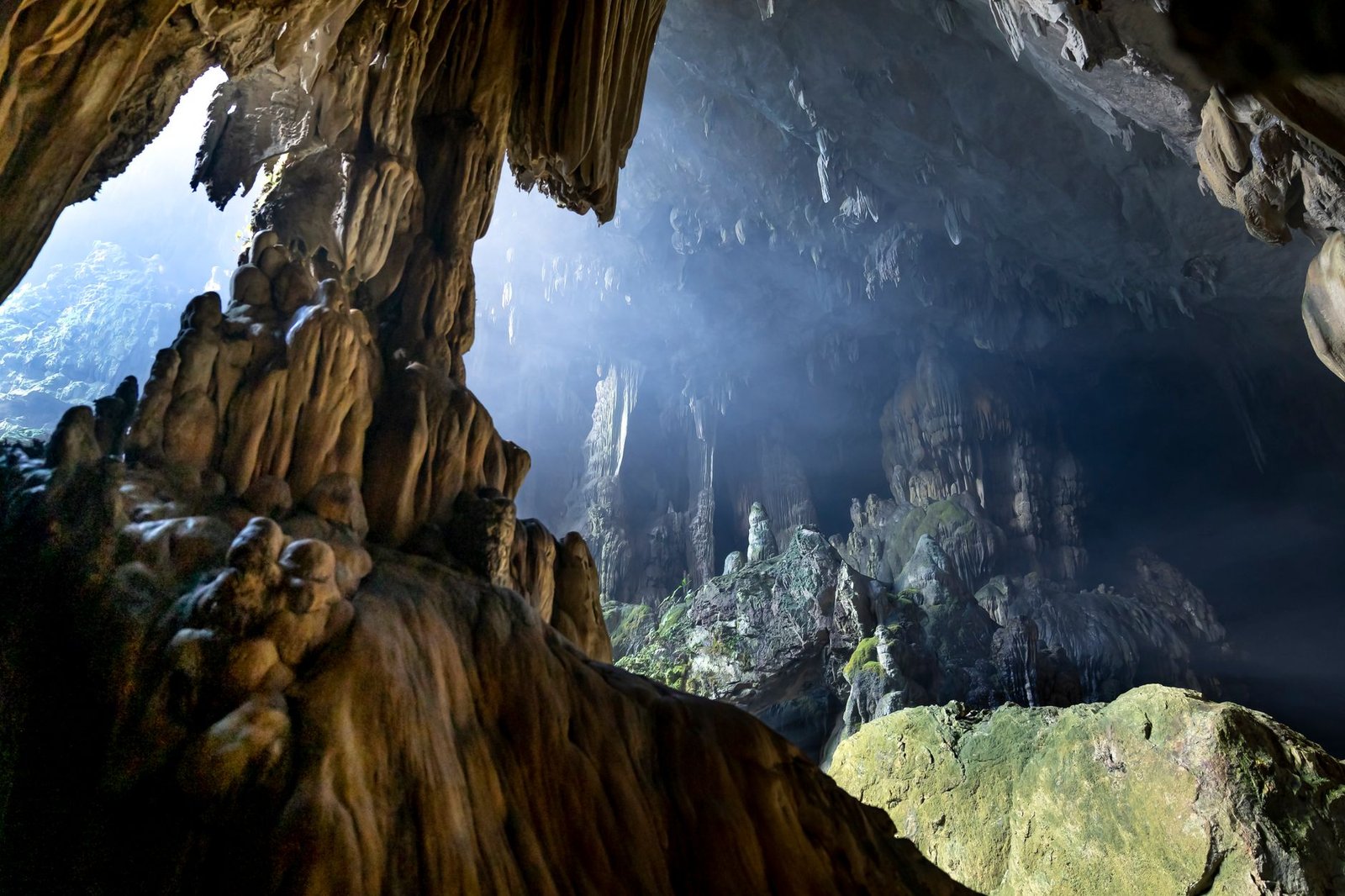
In 1992, a farmer in the village of Shiyan Beicun, in China’s Zhejiang province, decided to pump the water out of a small pond that locals believed was bottomless. Days of pumping later, the water level dropped — and revealed not a pond floor, but the mouth of an enormous, entirely artificial cavern. Over the following months, villagers drained more “bottomless ponds” nearby, and each one opened onto another vast chamber. Today we know of at least 24 hand-carved grottoes hidden beneath a single hill, some the size of cathedrals. And nobody knows who made them, when, or why.
A Discovery Hidden Beneath the Water
The Longyou Caves (sometimes called the Xiaonanhai Stone Rooms) were not natural. Once drained, they revealed walls, pillars, and ceilings deliberately shaped by human hands. The largest chambers plunge roughly 30 meters below the surface and cover thousands of square meters. Steep flights of carved steps descend from the entrances into gloomy halls supported by great columns of solid rock.
What makes the site so unsettling is how ordinary it looked from above. For centuries, villagers had lived, farmed, and fished directly over these hollow spaces without realizing what lay beneath their feet. The pools were simply part of the landscape — cold, deep, and stocked with fish. It took a farmer’s stubborn curiosity to expose one of the most puzzling engineering feats in China’s history.
The Scale That Stuns Engineers
When you ask who carved the Longyou Caves in China, the first thing that strikes you is the sheer volume of removed stone. Estimates suggest that excavating all the known caverns meant cutting away close to a million cubic meters of rock — by hand, in a fine-grained siltstone. That is a staggering amount of labor by any pre-industrial standard.
The caves were carved with remarkable precision. The walls slope at consistent angles. The support pillars are placed with an apparent understanding of load and structure, echoing the shape of the chambers around them. The ceilings, walls, and columns are all covered in parallel chisel marks — rows of fine, evenly spaced grooves that run in ordered diagonal bands across every surface. The consistency of these tool marks across chambers suggests either a shared technique or a coordinated workforce following the same method.
The Mysteries That Refuse to Add Up
Here is where the Longyou Caves cross from impressive to genuinely baffling. First, there is no written record of them anywhere. Chinese civilization is famous for meticulous bureaucratic documentation — dynasties recorded tax rolls, construction projects, and public works in obsessive detail. Yet a project requiring thousands of laborers over years left no mention in any known text.
Second, where did all the excavated stone go? Removing a million cubic meters of rock should leave enormous spoil heaps in the surrounding area, but no such debris field has been convincingly identified. Third, the individual caverns sit remarkably close together — in places the rock walls separating one chamber from the next are only a few meters thick. Carving blind, without modern surveying tools, the builders never once broke through into an adjacent cave. That implies planning of extraordinary accuracy.
Finally, despite lying flooded for what may be many centuries, the chisel marks remain crisp and the walls largely intact — a testament to careful workmanship in a stone that resists erosion.
Theories About Who Built Them
So who did carve them? Researchers have floated several ideas, none fully satisfying. Some propose the caves were imperial tombs or a mausoleum complex, though no burials, bodies, or grave goods have been found. Others suggest they were vast storage depots or granaries, cool underground vaults for keeping food or supplies — but the damp environment argues against long-term storage.
A popular theory holds that they were stone quarries, the caverns simply being the empty space left after builders extracted siltstone for construction elsewhere. This is plausible in scale, yet it fails to explain the decorative chisel patterns, the deliberate architectural pillars, and the total absence of the finished structures such enormous quantities of stone should have produced.
More dramatic proposals imagine a hidden military base, a secret site for a rebel army, or even a labor project connected to an ancient king preparing for war. Dating is equally uncertain: many scholars place the excavation sometime before the Qin dynasty (before 221 BCE), based on comparisons with local rock formations and tool marks, but a firm date remains elusive. The mystery of lost engineering knowledge echoes other head-scratchers, from the Antikythera Mechanism to the vanished builders of the underground city of Derinkuyu.
Why the Silence Is the Strangest Clue
Of all the riddles, the historical silence is the most haunting. Great engineering projects tend to be sources of pride, recorded and celebrated. The Longyou Caves were apparently forgotten so completely that they filled with water and slipped out of memory entirely, becoming nothing more than a set of “bottomless” village ponds.
That suggests one of two possibilities: either the caves were meant to be secret from the beginning, or the civilization that built them was disrupted so severely that its knowledge was lost. Both scenarios are provocative. A project on this scale would require a wealthy, organized society with skilled labor and strong central control — the kind of society that usually leaves its mark on history. Instead, whoever built Longyou left behind only silent stone and unanswered questions.
Step Down Into the Darkness With Us
The Longyou Caves remain one of the most underrated mysteries in the world — a hand-carved underground world hidden in plain sight for centuries, with no builders, no records, and no explanation. The deeper you look, the stranger it becomes.
We’ve turned the full story into a cinematic deep-dive on our Mysteries of History YouTube channel, walking through the chambers, the theories, and the clues the excavators found in the dark. If you want to see these astonishing caverns and weigh the evidence for yourself, hit play on the video and subscribe — the mystery of who carved the Longyou Caves is one you’ll want to explore with us.
Enjoyed this? More videos on the Mysteries of History YouTube channel.