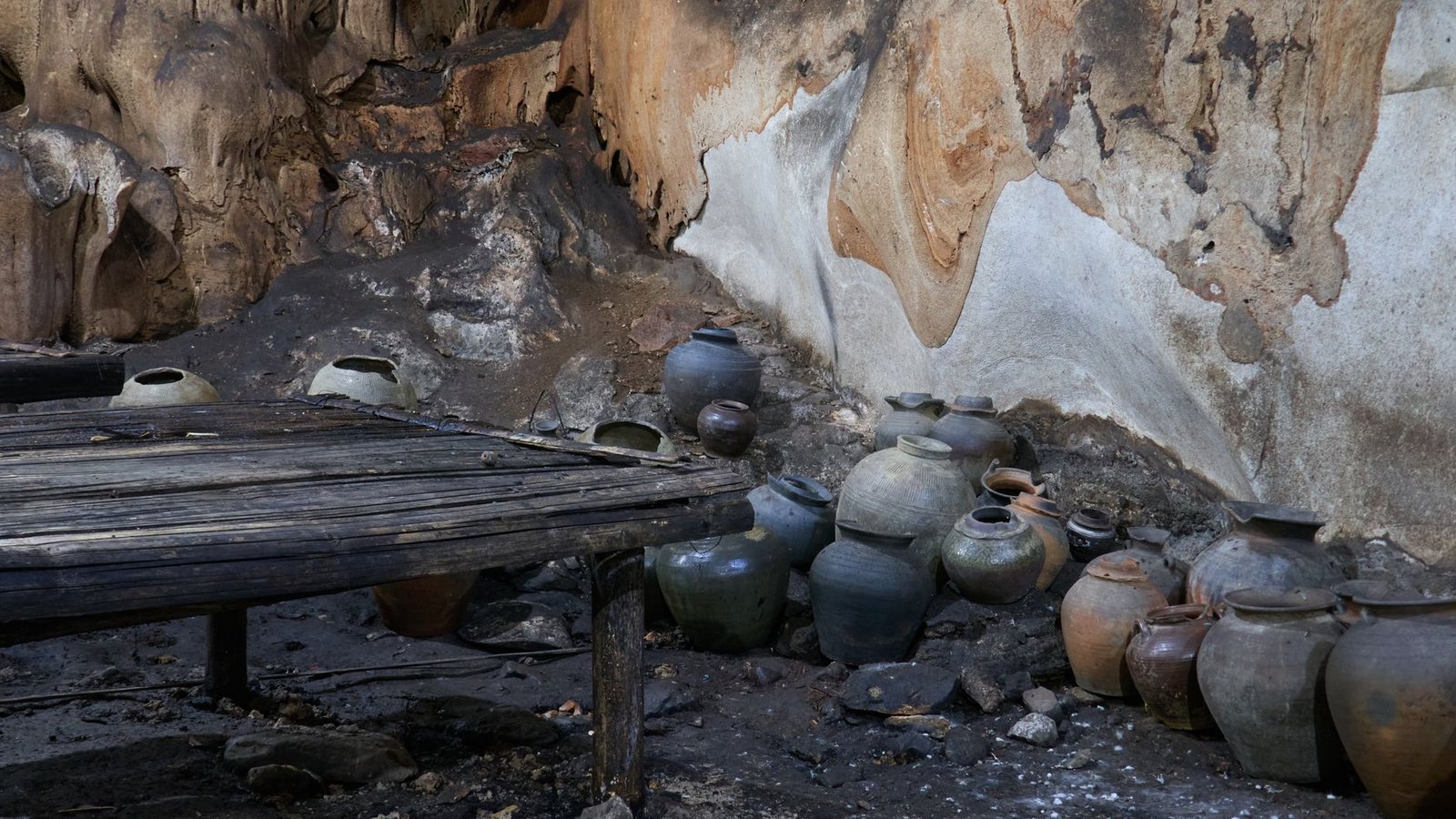
Scattered across the misty highlands of central Laos lie thousands of colossal stone jars, some taller than a grown adult and weighing several tons. They sit in clusters on hillsides and plateaus, lidless and silent, hewn from solid rock by hands no one can name. For decades, these vessels have puzzled archaeologists, locals, and travelers alike. The question that hangs over the landscape is deceptively simple: who built the Plain of Jars in Laos, and why did they carve so many enormous containers and then vanish, leaving no written record behind?
A Landscape Littered With Giants
The Plain of Jars is not a single site but a network of more than 90 separate locations spread across Xiangkhoang Province in northern Laos. In total, archaeologists have catalogued over 2,000 of these megalithic vessels. Most are carved from sandstone, though some are made from granite, limestone, or conglomerate rock. The largest stand around three meters tall and weigh as much as 14 tons.
What strikes visitors first is the sheer scale of the effort. These were not casual objects. Each jar required quarrying, shaping, hollowing, and transporting over considerable distances — sometimes many kilometers from the nearest stone source. A few of the jars once had stone lids, and decorated discs have been found nearby, hinting at a level of ceremony and craft that demanded organized labor and shared purpose.
The Burial Theory: Vessels for the Dead
The most widely accepted explanation among researchers is that the jars were part of an elaborate funerary tradition. Excavations led by French archaeologist Madeleine Colani in the 1930s uncovered human remains, burned bone, glass beads, and bronze and iron objects in and around the jars. Colani proposed that the vessels were used in a process of distillation of the dead — bodies may have been placed inside the jars to decompose before the remains were cremated or reburied elsewhere.
More recent work has strengthened this picture. Archaeologists have found burial pits surrounding the jars, containing bones interred in different ways: some bundled, some in ceramic vessels, some cremated. The jars themselves may have served as a temporary stage in a multi-step ritual of death and transformation, rather than simple coffins. If correct, the people who built them held sophisticated beliefs about the journey from life to the afterlife.
Dating the Mystery
For a long time, pinning down the age of the jars proved frustratingly difficult. The stone itself cannot be carbon-dated, and looting and wartime disturbance scrambled much of the evidence. But using optically stimulated luminescence — a technique that measures when buried sediment was last exposed to sunlight — researchers have dated the placement of some jars to roughly 1240 to 660 BCE.
That means the vessels are around 3,000 years old, placing their creators firmly in the Iron Age of Southeast Asia. This timeline reshapes the question entirely. We are not looking at a recent or medieval people, but at an ancient society that flourished long before the kingdoms that later dominated the region. They were skilled metalworkers and quarrymen, connected to trade networks that brought glass and carnelian beads into the highlands.
Who Were the Builders?
Here lies the heart of the enigma. Despite the scale of their achievement, the people who carved the jars left behind no inscriptions, no temples, and no settlements that have been clearly identified. We do not know what language they spoke or what they called themselves. They are defined entirely by what they made.
Local Lao legend offers a colorful alternative: the jars were said to have been built by a race of giants ruled by a king named Khun Cheung, who created the vessels to brew and store enormous quantities of rice wine to celebrate a great military victory. While the giants are folklore, the story may preserve a faint memory of the jars’ communal and ceremonial importance.
Modern archaeology suggests the builders were a settled Iron Age culture with the social organization needed to coordinate quarrying, carving, and transport across rugged terrain. The recurring placement of jars near quarries and along what may have been ancient routes hints at a society that mapped meaning onto its landscape — much like other megalith builders elsewhere in the world. The mystery of vanished peoples who left only stone behind echoes other great puzzles, from the collapse of the Indus Valley Civilization to the abandoned cities of the Americas.
Why the Site Remains So Hard to Study
The Plain of Jars carries a tragic modern footnote that has long hampered research. During the Secret War of the 1960s and early 1970s, Laos became one of the most heavily bombed countries in history. Vast quantities of unexploded ordnance still litter the region, making large stretches of the jar fields dangerous to excavate. Researchers must work within cleared corridors, and many clusters remain untouched.
Despite these obstacles, the effort to understand the site has gained momentum. In 2019, the Plain of Jars was inscribed as a UNESCO World Heritage Site, recognizing both its archaeological importance and its fragility. Ongoing surveys continue to map new jar clusters and refine the burial timeline, slowly drawing the outline of a forgotten civilization. Yet for every answer, new questions emerge: How were the jars transported? Why were certain hillsides chosen? And what happened to the culture that made them?
The Story Continues on Our Channel
The Plain of Jars is one of those rare places where an entire society speaks to us only through stone — and still keeps most of its secrets. The funerary theory, the Iron Age dating, and the lost identity of the builders together form one of Asia’s most underrated archaeological riddles. If you want to see these haunting megaliths up close, walk through the jar fields, and hear the full investigation into who carved them and why, head over to our Mysteries of History YouTube channel, where we bring this lost world vividly to life. Subscribe and join us as we keep unearthing the past, one mystery at a time.
Enjoyed this? More videos on the Mysteries of History YouTube channel.