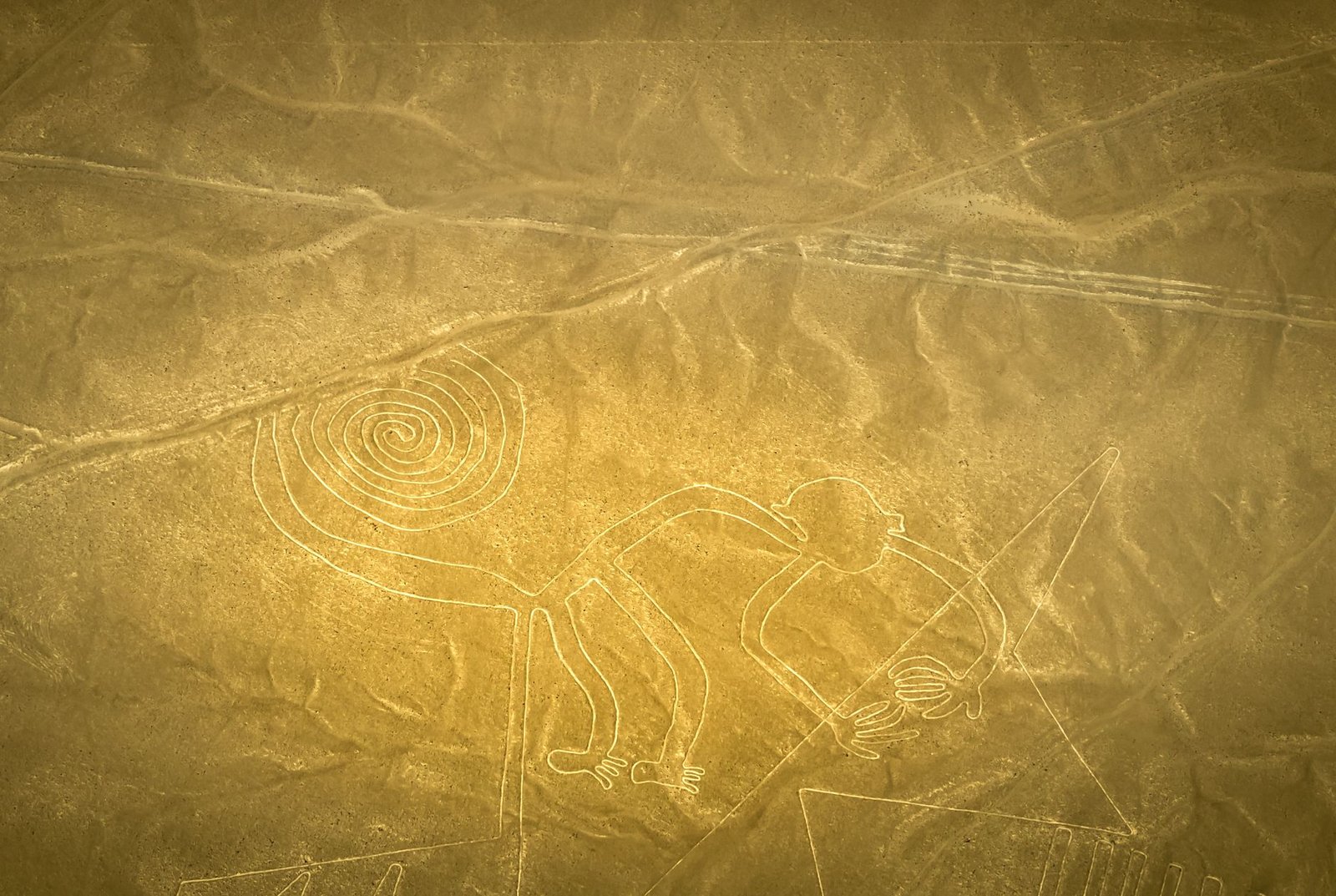
Etched across a sun-scorched plateau in southern Peru are drawings so vast that no one living below could ever see them whole. A hummingbird 300 feet long. A monkey with a spiraled tail. A spider, a killer whale, arrow-straight lines running for miles across ravines and hills as if the ground itself had been ruled with a cosmic straightedge. For nearly a century, one question has haunted everyone who stares down at them from an airplane window: what were the Nazca Lines used for, and how did a people without flight design something meant to be seen from the sky?
A Gallery Carved Into the Desert Floor
The Nazca Lines sit on the Pampa de Jumana, a stretch of the arid coastal desert between the towns of Nazca and Palpa. They were made by the Nazca culture, which flourished roughly between 100 BCE and 800 CE, though some of the straight lines may be older still, linked to the earlier Paracas people.
The technique itself is almost disappointingly simple — and that simplicity is exactly why the figures survive. The desert surface is covered in a layer of reddish-brown, iron-oxide-coated stones. By raking those darker pebbles aside, the Nazca exposed the pale, yellowish clay beneath, creating lines of high contrast. Because this is one of the driest, most windless places on Earth, those shallow furrows have barely shifted in 1,500 years.
There are hundreds of designs in total: around 70 recognizable biomorphs (animals and plants), dozens of stylized humanoid figures, and thousands of geometric shapes and lines. Some straight lines stretch for over five miles, deviating by only a few yards.
The Astronomy Theory That Faded
When researchers first tried to answer what the Nazca Lines were used for, the sky seemed the obvious place to look. In the mid-20th century, the German-born mathematician Maria Reiche devoted her life to the desert, mapping the figures and arguing that the lines formed a giant astronomical calendar — markers aligned to solstices, star risings, and the movement of the sun.
It was a seductive idea, and Reiche’s tireless work genuinely saved the site from destruction. But when astronomers ran the alignments through rigorous statistical testing in the 1960s and beyond, the calendar hypothesis largely collapsed. With so many lines pointing in so many directions, a handful were bound to line up with celestial events by pure chance. The sky, it turned out, could not explain the pattern as a whole.
Following the Water
The theory with the strongest footing today has nothing to do with stars — and everything to do with survival. The Nazca lived on the edge of one of the harshest deserts on the planet, where rainfall is almost nonexistent and water meant life or death.
Anthropologists such as Johan Reinhard noticed that many lines seem to point toward sources of water or toward the mountains where water originates. Others connect to ceremonial centers like the great pilgrimage site of Cahuachi. The leading interpretation is that the lines were ritual pathways — sacred routes to be walked in processions, part of ceremonies pleading with the gods and mountain spirits for rain and fertility.
The animal figures fit this reading, too. The hummingbird, the monkey, the killer whale — many are associated in Andean belief with water and fertility. Broken pottery found scattered along certain figures suggests offerings were smashed as people moved through them, treating the drawings not as art to be viewed but as spaces to be entered.
Made to Be Walked, Not Seen From Above
Here is the twist that dissolves the biggest “mystery”: the Nazca almost certainly never intended their work to be admired from the air. That is a modern obsession, born the moment commercial planes began crossing Peru in the 1920s and pilots reported strange shapes below.
Many of the biomorphs are drawn as a single continuous line that never crosses itself — a path you could walk from start to finish and exit near where you began. That design makes little sense for a picture meant to be viewed whole, but perfect sense for a processional route traced on foot during ritual.
As for how ancient people achieved such precision without flight, experiments have shown it needs no advanced technology at all. Using wooden stakes, cord, and simple sighting techniques — the same geometry any culture that builds straight walls understands — small teams can scale up a sketch to enormous size. The ancient astronaut claims, which insist only extraterrestrials could have guided the work, quietly ignore that these people were master engineers of their own landscape. The same lazy “aliens did it” logic gets thrown at every monumental feat, from the Easter Island statues to the world’s oldest temple at Göbekli Tepe — and it consistently underestimates human ingenuity.
The Questions Still Unanswered
Saying the lines were sacred pathways for water rituals doesn’t close the case. Why these particular animals? What did each figure mean to the community that made it? Why were some designs seemingly drawn once and never reused, while lines were re-raked over generations?
New discoveries keep reshaping the picture. Using drones and AI-assisted imaging, researchers have identified hundreds of previously unknown figures in recent years, many smaller and older than the famous giants, often depicting human-like beings and domesticated animals along footpaths. Each new find complicates the neat theories — and reminds us that we are still reading only fragments of a vast, deliberate message left by a vanished people.
Walk the Desert With Us
The Nazca Lines are proof that the deepest mysteries aren’t always about how — they’re about why a culture would pour generations of labor into something they could never fully see. We’ve only traced the outline here. On the Mysteries of History YouTube channel, we take you across the Pampa itself, breaking down the water cults, the lost city of Cahuachi, and the newest discoveries reshaping everything. Hit play, subscribe, and follow the lines with us to where they truly lead.
Enjoyed this? More videos on the Mysteries of History YouTube channel.