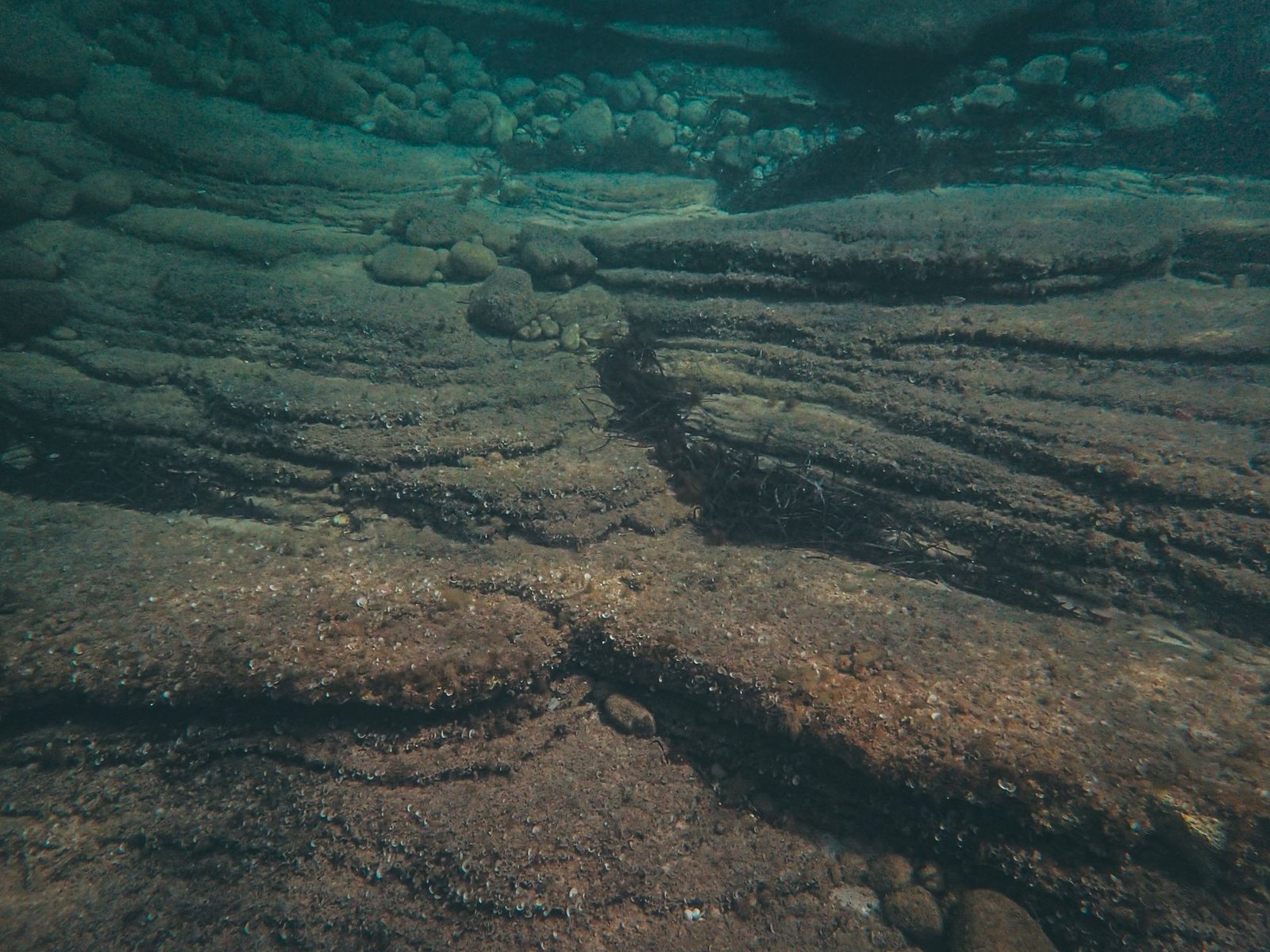
Off the southern tip of Japan, beneath the restless waters of the Ryukyu Islands, lies a submerged stone formation that has divided scientists for more than thirty years. Sharp right angles, flat terraces, and what look like carved steps rise from the seabed near the island of Yonaguni. To some divers it is unmistakably the ruin of a lost civilization, drowned when the ice age ended. To geologists it is a natural sculpture, shaped by nothing more exotic than rock, current, and time. So the question refuses to go away: is the Yonaguni Monument man-made, or is it one of the ocean’s great illusions?
The Discovery That Started the Debate
In 1986, a local dive operator named Kihachiro Aratake was searching for hammerhead sharks off Yonaguni when he stumbled onto something far stranger than fish. About 25 meters below the surface, he found a massive stepped structure of sandstone, its edges startlingly straight, its surfaces arranged in broad flat platforms. The formation stretches roughly 100 meters long and rises around 27 meters from the seabed.
Word spread quickly, and the site became a magnet for divers and researchers. The most vocal champion of the man-made theory was Masaaki Kimura, a marine geologist at the University of the Ryukyus. After years of dives, Kimura argued the monument was not a chance formation at all but a deliberately shaped complex — a sunken city, temple, or ceremonial platform carved by people thousands of years ago. His claims turned a quiet dive spot into one of the most contested underwater sites on Earth.
What the Monument Actually Looks Like
Up close, the appeal of the man-made theory is obvious. The structure features what look like enormous flat terraces, sharp 90-degree corners, straight walls, and a set of gigantic steps. Kimura and his supporters also point to features they interpret as a road, twin megalithic pillars, a stone shaped vaguely like a turtle, and even faint markings they read as carvings or an early script.
The geology matters here. Yonaguni’s bedrock is a fine-grained sandstone and mudstone that fractures along natural planes. When such rock breaks, it tends to shear along straight lines and clean angles, producing steps and rectangular blocks that can look uncannily engineered. That single fact sits at the heart of the entire controversy: the very material that makes the monument look artificial is also perfectly capable of creating those shapes on its own.
The Case for a Drowned Civilization
Supporters of the man-made reading raise a compelling point about timing. If the structure was ever above water, it would have been dry land during the last ice age, when sea levels were far lower. Geologists estimate the site would have last stood above the waves roughly 10,000 years ago. If humans shaped it then, the monument would be older than Stonehenge and older even than Göbekli Tepe, forcing a dramatic rewrite of when advanced stoneworking began.
That possibility is intoxicating. It connects Yonaguni to the deep human dream of a lost golden age swallowed by the sea — the same instinct behind the legend of Atlantis. Kimura also argued that certain rocks appear to have been moved or stacked in ways currents alone could not manage, and that debris expected from purely natural erosion is oddly absent from some terraces. For believers, these anomalies are fingerprints of human hands.
Why Most Geologists Say Nature Did It
The scientific mainstream remains deeply skeptical, and their reasoning is grounded in how sandstone behaves. Robert Schoch, a geologist from Boston University known for his own unconventional views on ancient sites, dived at Yonaguni and concluded the monument is most likely natural. He noted that the parallel fracture lines and terraces follow the rock’s natural bedding planes and joint patterns — exactly what you would expect from layered sedimentary stone splitting along its weak points.
Critics also point out that the “steps” and “walls” remain connected to the surrounding bedrock rather than being separate quarried blocks. There is no scattering of clearly worked tools, no undisputed inscriptions, no pottery, no burials — none of the supporting debris that usually surrounds a genuine ancient settlement. Human brains are relentless pattern-seekers; we see faces in clouds and cities in rock. To many experts, Yonaguni is a spectacular case of that instinct meeting an unusually cooperative geology.
The Questions That Keep Yonaguni Alive
So is the Yonaguni Monument man-made? The honest answer is that the evidence tilts strongly toward natural formation, but it does not slam the door completely. A middle position has quietly gained ground: perhaps the core is natural, yet ancient people who lived on the then-dry land modified or enhanced parts of it, cutting steps or shaping surfaces around forms nature had already begun. That would explain both the geological patterns and the tantalizing sense of intention.
Proving it is brutally difficult. Underwater archaeology is expensive and dangerous, currents at the site are ferocious, and any organic material that could be dated has long since vanished. Without carved objects, hearths, or human remains, the debate rests on interpretation rather than proof — which is precisely why it endures. Like the drowned mysteries of the Bronze Age collapse, Yonaguni reminds us how much of the past may now lie beneath the waves, beyond easy reach.
Dive Deeper Into the Mystery
The Yonaguni Monument sits at the exact fault line where geology, archaeology, and imagination collide — a place where the ocean refuses to give a clear verdict. Whether it is the ruin of a forgotten people or a masterpiece of natural stone, it forces us to ask how well we really know our own prehistory.
We’ve explored this haunting underwater enigma in full on the Mysteries of History YouTube channel, with the dive footage, the rival theories, and the geology laid out side by side. If this drowned puzzle grabbed you, hit the button below and watch the complete story unfold — then decide for yourself what nature built and what human hands may have touched.
Enjoyed this? More videos on the Mysteries of History YouTube channel.