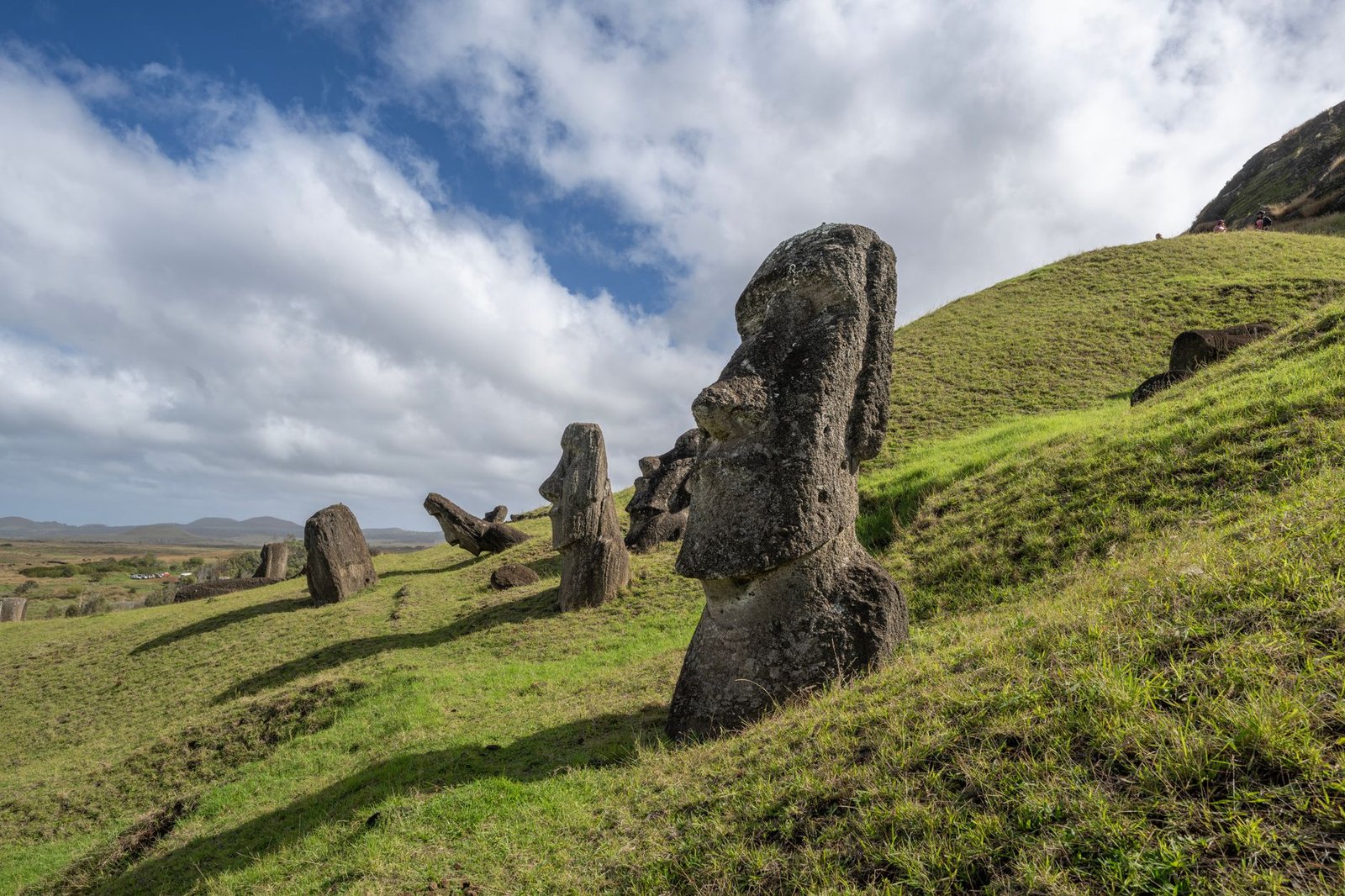
Stand before a row of the moai, the brooding stone giants of Easter Island, and one question swallows all the others: how did a small Polynesian community drag hundreds of multi-ton statues across miles of broken volcanic ground without wheels, draft animals, or metal tools? For centuries outsiders found the feat so improbable they reached for fantastical explanations. But the islanders themselves always gave a stranger, simpler answer — one that modern researchers are finally taking seriously.
The Scale of an Impossible Problem
Easter Island, known to its people as Rapa Nui, is one of the most isolated inhabited places on Earth, a speck of land more than 2,000 miles from the nearest continent. On it stand nearly 900 moai, carved between roughly 1250 and 1500 CE. Most were quarried at Rano Raraku, a volcanic crater on the island’s eastern flank, then transported to stone platforms called ahu scattered along the coast.
The statistics are staggering. The average moai weighs around 12 tons, and some unfinished giants in the quarry top 80 tons. Many had to travel six to ten miles over uneven terrain. When the first European visitors arrived in 1722, they found an island almost stripped of large trees and a population far too small to obviously manage such engineering. Naturally, the question of how were the Easter Island statues moved became one of archaeology’s most stubborn puzzles.
Theories That Went Too Far
Into that vacuum of evidence rushed some spectacular guesses. In the mid-20th century, fringe authors suggested the moai were the work of a lost super-civilization, or even — in the most famous flight of fancy — that ancient astronauts lent a hand. These ideas tend to share a quiet, troubling assumption: that the ancestors of the living Rapa Nui people simply could not have built their own monuments.
That assumption is wrong, and the archaeology consistently shows it. The same instinct has haunted other ancient wonders, from how the Egyptian pyramids were built to the megaliths of Göbekli Tepe. Again and again, the real answer turns out to be human ingenuity, careful planning, and a great deal of coordinated labor — not visitors from the stars.
The Theory That the Statues Lay Down
The explorer Thor Heyerdahl, of Kon-Tiki fame, championed the most intuitive idea in the 1950s: the moai were laid flat on their backs, hauled onto wooden sledges, and dragged over log rollers by teams of workers. Heyerdahl even paid a group of islanders to demonstrate, and they managed to inch a statue along the ground.
The horizontal-transport theory fit the deforestation story neatly. By this reasoning, the Rapa Nui felled their once-abundant palm forests to build sledges and rollers, eventually stripping the island bare. It became the centerpiece of a famous “ecological suicide” narrative — a society that destroyed its environment to feed an obsession with statue-building. It was tidy, dramatic, and for decades widely accepted. But it didn’t quite match what the islanders had been saying all along.
”The Statues Walked”
Rapa Nui oral tradition never described statues being dragged on their backs. The elders insisted that the moai walked to their platforms — that the giants moved upright, swaying their way across the island as if alive. For a long time scholars treated this as poetic myth.
Then archaeologists Terry Hunt and Carl Lipo decided to test it. They noticed that the moai destined for transport had a distinctive forward-leaning posture and a wide, D-shaped base — features that would make a standing statue awkward to lay down but perfect to rock from side to side. In a 2012 experiment, a team of fewer than 20 people used three ropes to tilt and “walk” a 5-ton replica down a road, rocking it left and right in a rhythmic shuffle. It moved hundreds of feet in under an hour.
The walking method elegantly explains details that puzzled earlier researchers: the statues found abandoned face-down along the old roads (they had toppled mid-journey), and the curved, hollowed paths radiating from the quarry. It also means far less timber was needed than the sledge theory demanded.
What This Tells Us About a Vanished World
If the moai really walked, the implications ripple outward. The feat required no army of slaves and no vanished super-race — just clever physics, strong rope made from plant fiber, and a community working in tight coordination. It reframes the Rapa Nui not as reckless destroyers of their island but as sophisticated engineers who understood balance, momentum, and leverage.
That matters, because the broader story of Easter Island’s “collapse” is now hotly debated too. Newer research suggests the population decline owed more to introduced rats devouring palm seeds, European diseases, and the brutal slave raids of the 1860s than to any self-inflicted ecological apocalypse. The walking moai theory is part of a wider rehabilitation of Rapa Nui’s reputation — a reminder that ancient people were rarely as foolish, or as helpless, as outsiders assumed. The debate isn’t fully settled; some researchers still favor a hybrid of methods. But the case for the walking statues keeps getting stronger.
See the Giants Walk for Yourself
The story of the moai is a perfect example of how a so-called myth can turn out to be the literal truth — and how listening to the people who built the monuments beats inventing aliens to explain them. There’s far more to it than a single experiment: the rivalries between clans, the meaning carved into each stony face, and the mystery of why statue-building suddenly stopped.
We’ve brought the whole saga to life on the Mysteries of History YouTube channel, with footage of the island, the quarry, and the walking experiment that changed everything. Hit play, watch the giants move, and decide for yourself how the Easter Island statues were really moved.
Enjoyed this? More videos on the Mysteries of History YouTube channel.