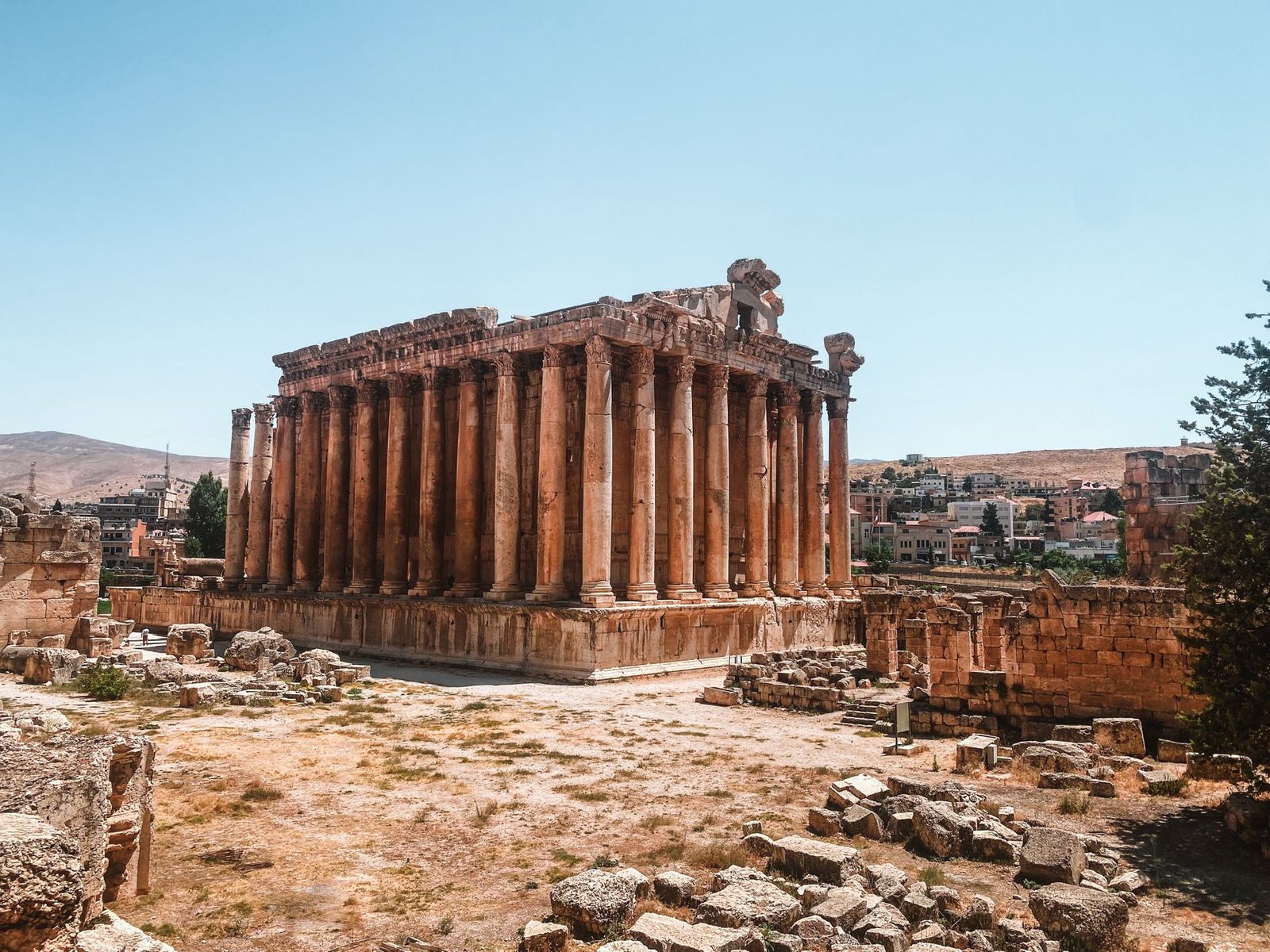
High in Lebanon’s Beqaa Valley sit three of the largest building blocks ever placed by human hands. Each stone in the Trilithon weighs an estimated 800 tons — heavier than a fully loaded Boeing 747, and roughly the weight of three blue whales stacked together. They rest in a wall at Baalbek, fitted so precisely that a knife blade struggles to slip between them. And nearby, in an ancient quarry, lies an even bigger monster: a single carved block estimated at over 1,000 tons, still half-attached to the bedrock. The obvious question refuses to go away: how were the Baalbek trilithon stones moved, lifted, and set into place with the technology of the ancient world?
The Stones That Break the Scale
Baalbek — known to the Romans as Heliopolis, “City of the Sun” — was home to one of the grandest temple complexes of the empire. The Temple of Jupiter once stood on a colossal raised platform, and it is within that platform’s foundation that the Trilithon sits. These three blocks are each about 19 meters long, 4 meters high, and 3.6 meters thick.
What astonishes engineers is not just the weight but the placement. The megaliths were raised roughly 7 meters off the ground and slotted onto a course of already-massive stones below. Moving 800 tons across level ground is one problem; lifting it and setting it with millimeter precision is another entirely. For comparison, the heaviest blocks in the Great Pyramid weigh a fraction of a single Trilithon stone.
Who Actually Built It — and When
A popular fringe claim insists the platform predates the Romans by thousands of years, built by some lost civilization. The archaeological evidence points elsewhere. Excavations have found Roman pottery, coins, and construction debris sealed beneath and around the megalithic courses, dating the platform’s expansion to the 1st century BC and 1st century AD — the reign of Augustus and his successors.
Baalbek was a working imperial project. The Romans were the greatest engineers of the ancient Mediterranean, capable of building aqueducts, domes, and harbors that still stand today. The Trilithon was almost certainly laid as part of their monumental temple podium. The real mystery isn’t who — it’s how they managed something at this scale even for them.
The Quarry That Gives the Game Away
The strongest clues sit less than a kilometer from the temple, in the ancient quarry. There you can still see the famous Stone of the Pregnant Woman (Hajar al-Hibla) and, discovered more recently, an even larger block weighing an estimated 1,650 tons — possibly the heaviest stone ever quarried by people.
Crucially, these giants were never moved. They lie exactly where they were carved. That matters enormously: it shows the Romans quarried on-site and transported blocks downhill and toward the temple, not across impossible terrain. The quarry sits at slightly higher elevation than the temple platform, meaning gravity could assist the haul. The unfinished blocks also reveal the carving technique — channels cut around each stone so it could be split from the bedrock.
How the Romans Likely Moved 800 Tons
So how were the Baalbek trilithon stones moved? The consensus among engineers and historians relies on well-documented Roman methods scaled up to their limit:
- Massive human and animal labor. Roman texts describe thousands of workers hauling monuments. With enough ropes and manpower, even 800 tons becomes movable on the right surface.
- Sledges and lubricated tracks. Blocks were likely dragged on wooden sledges over prepared roadbeds, possibly greased or wetted to cut friction — a technique used across the ancient world.
- Rollers and log tracks. Timber rollers under a sledge dramatically reduce the force needed to move enormous loads.
- Levers, capstans, and earthen ramps. To raise the stones 7 meters, the Romans could have built ramps of packed earth and rubble, then removed them after placement, combined with lever systems and rope-driven capstans for fine positioning.
Experiments and calculations suggest that with organized labor in the thousands, these methods are physically sufficient. The Romans had already moved obelisks weighing hundreds of tons from distant provinces — the engineering knowledge existed. Baalbek simply pushed it to an extreme.
Why the Mystery Still Grips Us
If the method is broadly understood, why does Baalbek keep appearing on lists of unexplained sites? Part of the answer is human: our intuition simply refuses to accept that people without engines and cranes could handle 800 tons. The sheer scale short-circuits common sense, which is exactly the emotional gap that “lost civilization” theories rush to fill.
But there are genuine open questions too. We have no surviving Roman account describing the exact machinery used at Baalbek. The precise sequence of lifting and placing the Trilithon remains a reconstruction, not a documented fact. Why the Romans chose to work at such an absurd scale — when smaller blocks would have done the job — is still debated. It may have been a deliberate demonstration of imperial power, engineering as propaganda.
Baalbek belongs to the same family of head-scratching megalithic feats as the Easter Island statues and the ocean-built walls of Nan Madol — sites where the how is more or less solved, yet the achievement still feels impossible. Standing beneath those stones, the awe is entirely justified.
We’ve only scratched the surface of Baalbek’s engineering, its Roman ambitions, and the theories that still divide experts. For the full story — the quarry, the machines, and the debate laid out in vivid detail — watch the complete deep-dive on our YouTube channel, where we bring these ancient stones back to life.
Enjoyed this? More videos on the Mysteries of History YouTube channel.