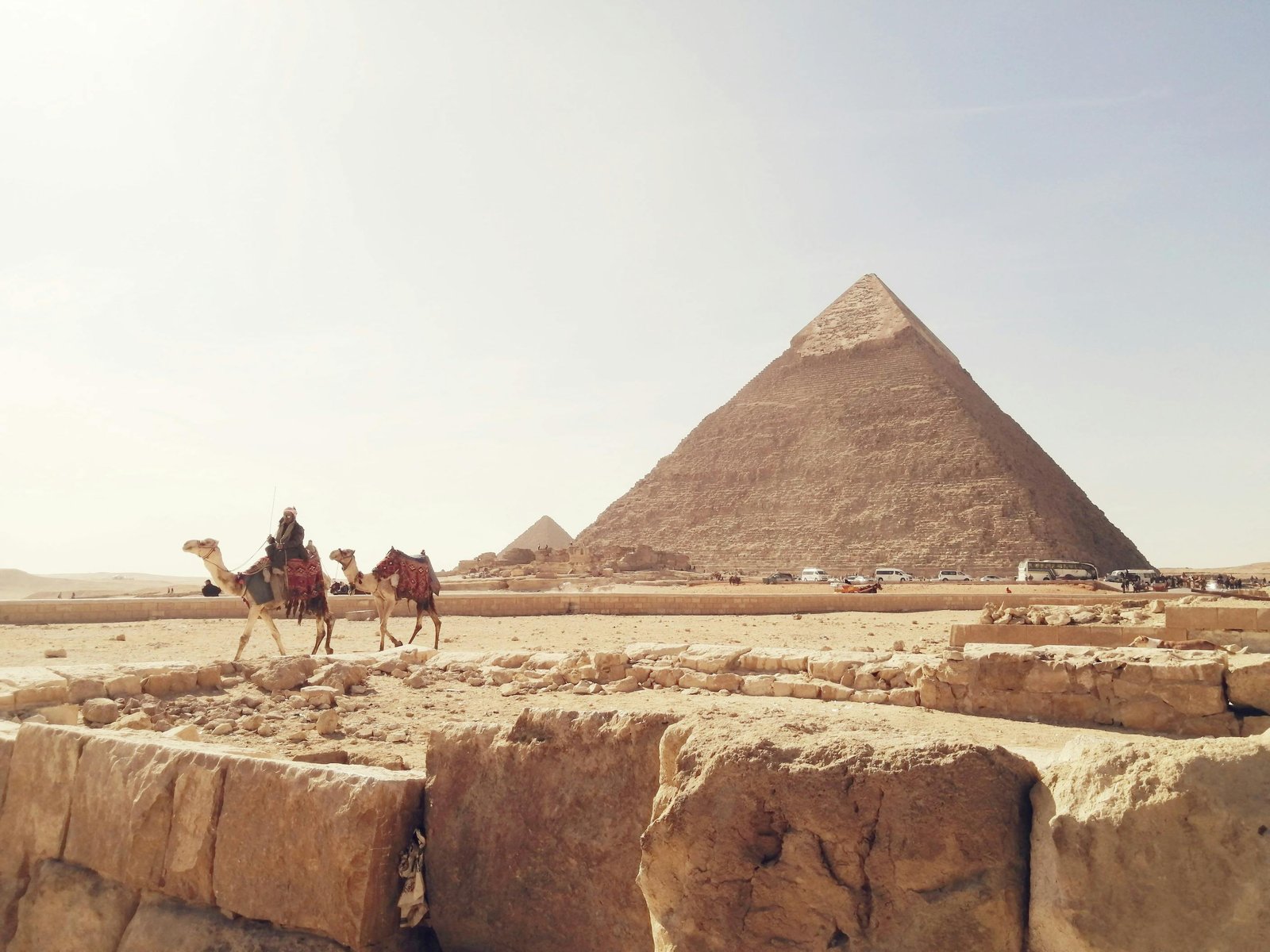
The puzzle that won’t go away
The Great Pyramid of Giza was built around 2560 BCE for the pharaoh Khufu. It contains an estimated 2.3 million stone blocks, weighing between 2.5 and 80 tons each, stacked to a height of 147 meters with seams so tight you cannot slip a knife between them.
It was the tallest human-made structure on Earth for 3,800 years. And we still don’t fully agree on how it was built.
What archaeology has actually settled
A few things are now firmly established, contrary to older speculation about aliens or lost civilizations:
- The pyramids were built by paid Egyptian workers, not slaves. Excavations near Giza led by Mark Lehner and Zahi Hawass uncovered workers’ villages — complete with bakeries, breweries, and the tombs of the workers themselves, buried with honors near the pyramids they built.
- The labor force was huge but not impossible. Estimates range from 20,000 to 30,000 workers, rotating seasonally, over roughly 20 years.
- The stones mostly came from nearby. The limestone core blocks were quarried right next to the construction site. The harder granite slabs used in the king’s chamber were transported around 800 km from Aswan.
So far, so conventional. The real arguments start with how the blocks were lifted.
The ramp problem
Nobody has fully cracked how 2.5-ton blocks reached 147 meters in the air with no pulleys, no wheels worth mentioning, and only copper tools.
The mainstream answer is ramps — long, gradual inclines made of mud brick and rubble that workers dragged blocks up using sledges, ropes and water-lubricated tracks. The disagreement is about what kind of ramp:
- Straight external ramps. Simple, but to reach the top of the pyramid one would have needed to be enormous — possibly larger in material than the pyramid itself.
- Zigzag or spiral ramps wrapping the pyramid. Smaller, but the corners create awkward turns for hauling massive blocks.
- Internal ramps, proposed by architect Jean-Pierre Houdin in 2007 — a spiral built inside the structure. Some scans of the Great Pyramid have shown anomalies that could fit this theory, though nothing definitive yet.
The Diary of Merer changed everything
In 2013, archaeologists working at Wadi al-Jarf on the Red Sea coast discovered a set of papyrus fragments dating to the reign of Khufu — the oldest inscribed papyri ever found. They were written by a mid-level official named Merer, who oversaw a crew of about 200 men transporting limestone from Tura to Giza.
Merer’s logbook records, day by day, how stones were moved by boat along canals that connected the Nile to the construction site. It is the first eyewitness document from anyone involved in building the pyramids — and it confirms the boat-and-canal model for transport, while still leaving the final lift onto the pyramid itself unexplained.
What’s still a mystery
The big remaining questions are mostly about precision and time:
- How did the builders align the pyramid to true north within a fraction of a degree, in an era without compasses?
- How did they cut and fit the granite slabs of the king’s chamber with seams that modern masons struggle to match?
- Are there internal chambers we still haven’t found? In 2017 and again in 2023, muon-detection scans revealed large unexplained voids inside the Great Pyramid. Nobody has been inside them.
The pyramids are not, as some videos still claim, impossible to explain. But they are not fully explained either — and the gap between “we have a working theory” and “we know” is exactly the part that keeps drawing people back to Egypt.
Enjoyed this? More videos on the Mysteries of History YouTube channel.