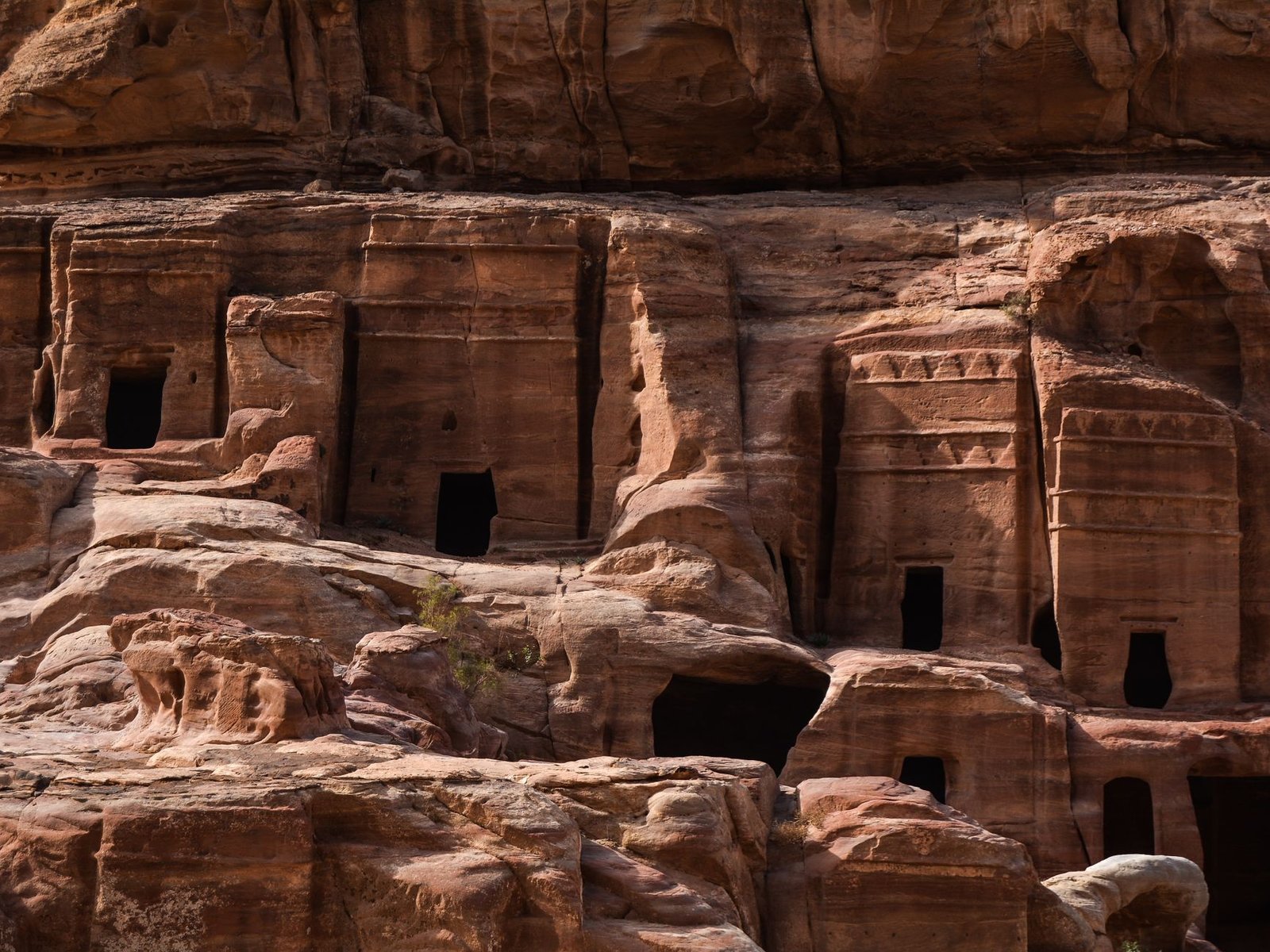
Imagine building a city of 20,000 people in a desert that gets barely six inches of rain a year — a place where the sun cracks stone and flash floods can drown a canyon in minutes. Now imagine that city becoming so wealthy it rivaled Rome, its treasury carved directly into rose-colored cliffs. That was Petra, capital of the Nabataean kingdom. The obvious question haunts every visitor who stumbles through its narrow gorge in the blistering heat: how did the Nabataeans get water in Petra at all? The answer is one of the most underrated engineering achievements of the ancient world.
A City That Should Never Have Survived
Petra sits in the mountainous desert of southern Jordan, tucked into a labyrinth of sandstone canyons. It is a spectacular place to hide a capital — defensible, dramatic, and utterly hostile to human life. The region receives only around 100–150 millimeters of rainfall a year, and most of that falls in short, violent winter storms rather than gentle showers.
That combination is deadly. Too little water most of the year means thirst; too much all at once means flash floods that tear through the very canyons the city depended on. Any civilization that wanted to thrive here had to solve two opposite problems simultaneously: capturing every possible drop of scarce water, and controlling the sudden torrents that could kill.
The Nabataeans, originally a nomadic Arab people who grew rich controlling the incense and spice trade, did exactly that. Their mastery of water was not a luxury — it was the foundation of everything they built.
The Hidden Genius of Nabataean Water
Walk through the famous Siq, the mile-long gorge that leads into Petra, and most people never notice the answer running along the walls beside them. Carved into the rock on both sides are shallow channels, once fitted with ceramic pipes, that carried a controlled flow of drinking water into the heart of the city.
The secret to how the Nabataeans got water in Petra lies in an integrated system that historians and hydrologists have spent decades reconstructing. It combined several ingenious elements:
- Terracotta pipelines with precisely sized diameters to control flow speed and prevent water from surging or stagnating.
- Dams and diversion walls that redirected dangerous floodwaters away from populated areas.
- Cisterns and reservoirs cut into solid rock to store water through the long dry season.
- Settling basins that let sediment drop out so the water arrived clean.
What makes this so impressive is the level of hydraulic understanding it reveals. The Nabataeans seem to have grasped that a pipe running only partly full, at a carefully calculated gradient, moves water more efficiently and with less pressure damage than a full pipe on a steep slope. That is engineering knowledge the Romans themselves prized.
Taming the Flash Floods
The deadliest threat to Petra was not drought but sudden water. A storm miles away could send a wall of water racing down the Siq with terrifying speed — a danger so real that in 1963, decades after the ancient system fell into ruin, a flash flood in the gorge killed a group of tourists.
The Nabataeans engineered around this. They built a dam at the entrance to the Siq to block floodwaters and diverted them through a specially cut tunnel into an adjacent valley, keeping the main passage safe and dry. This meant the same processions and trade caravans could enter the city without ever facing the torrent.
Essentially, they turned their greatest enemy into a managed resource. Floodwater that would otherwise be lost or lethal was slowed, split, and steered into storage. Modern engineers who have studied the layout describe it as a genuine watershed management system — an entire landscape re-plumbed by hand.
Harvesting Every Drop
Beyond the dramatic flood defenses, Petra’s survival rested on relentless, patient water harvesting. The surrounding hills were dotted with hundreds of cisterns, many hidden and sealed with waterproof plaster to stop evaporation and seepage. Rainwater running off bare rock was funneled along carved gutters straight into these hidden tanks.
Spring water was piped in from sources several kilometers away, including the reliable spring at nearby Ain Musa. By blending distant spring flow with locally harvested rain and stored floodwater, the Nabataeans built redundancy into their supply — if one source failed, others could compensate.
Estimates suggest their combined system could support tens of thousands of residents plus the constant traffic of trade caravans and their thirsty camels. In a place with almost no rain, they created not just survival but abundance: gardens, fountains, and even what may have been an ornamental pool and pavilion complex, a deliberate, showy display of water as wealth in the middle of a desert. Controlling water was how the Nabataeans advertised their power.
Why the Knowledge Faded
If the system was so brilliant, why did it vanish? Part of the answer is politics. Rome annexed the Nabataean kingdom in 106 CE, and while Petra endured for a time, shifting trade routes gradually drained away its economic lifeblood. A powerful earthquake in 363 CE damaged many structures, including parts of the water network, and later quakes did more harm.
As population and resources declined, there was no longer the labor or wealth to maintain the intricate channels, pipes, and dams. Sediment clogged the cisterns; the desert reclaimed the gorges. The knowledge that once let a city bloom in the sand slowly slipped away, leaving behind carved grooves in the rock that most modern visitors walk past without a second glance.
Like the vanished know-how behind so many ancient wonders — from the precision of the Antikythera Mechanism to the collapse of the Indus Valley cities — Petra reminds us that advanced technology can be lost as easily as it is invented.
See Petra’s Lost Engineering Come Alive
The rose-red city is far more than a beautiful backdrop for adventure films. It is a monument to human ingenuity, a place where a desert people out-engineered the elements and built an empire on the mastery of water itself. The carved channels of the Siq are the fingerprints of forgotten geniuses.
If you want to walk through Petra’s hidden waterways, see how the flood tunnels worked, and understand the full story of how the Nabataeans conquered a waterless canyon, watch our deep-dive video on the Mysteries of History YouTube channel — and subscribe so you never miss the next lost civilization we uncover.
Enjoyed this? More videos on the Mysteries of History YouTube channel.